

Targeting the wrong keyword is like putting the wrong postcode into your satnav. You’ll follow every instruction, make good progress… and still end up miles from where you wanted to be.
Your keyword research tool is where that postcode comes from. You need data you can trust, a tool that’s worth its weight in gold, and one you can get on with straight away, without wading through jargon or losing an afternoon to a new dashboard.
Pair the right tool with a few tips for effective keyword research, and you’ll be targeting terms you can realistically win, from local searches to AI search visibility and the gaps your competitors have left open.
The Best Keyword Research Tools at a Glance
Every keyword analysis tool on this list earns its place for a different reason. Here’s how they compare on what they do best, what they cost and what users think of them.
| Tool | Best For | Starting Price | G2 Rating |
| Semrush | All-round research, AI search and competitor research | Free plan, paid from £95.07/month billed annually | 4.4/5 (4,000+ reviews) |
| SE Ranking | Value for money | £95/month, or £76/month billed annually | 4.8/5 (1,400+ reviews) |
| Google Search Console | Free insights for existing sites | Free | 4.7/5 (500+ reviews) |
| AlsoAsked | Question and People Also Ask research | Free plan, paid from around £9/month | 4.8/5 (45 reviews) |
| KWFinder | Local search | Free plan, paid from around £28.36/month billed annually | 4.7/5 (Mangools, 95 reviews) |
Prices are correct as of October 2026 and may not include tax. KWFinder bills in US dollars, so its prices are converted and may vary slightly at checkout.
How We Chose These Keyword Tools
We use keyword research tools every day for client work, so we’ve got a good idea of which ones earn their keep.
For this list, we looked for tools that give you data you can trust, with proper coverage of UK searches. They had to be fair value in pounds, ideally with a free tier or trial so you can test them before you commit, and easy enough to pick up without a steep learning curve or a wall of jargon.
We also checked what real users think, using G2 ratings for every tool so you know you’re comparing apples with apples. And because more people now search with AI tools like ChatGPT, we gave extra credit to tools that help you research the questions and prompts people use there too.
Our Top Keyword Analysis Picks Reviewed
1. Semrush: Best Overall
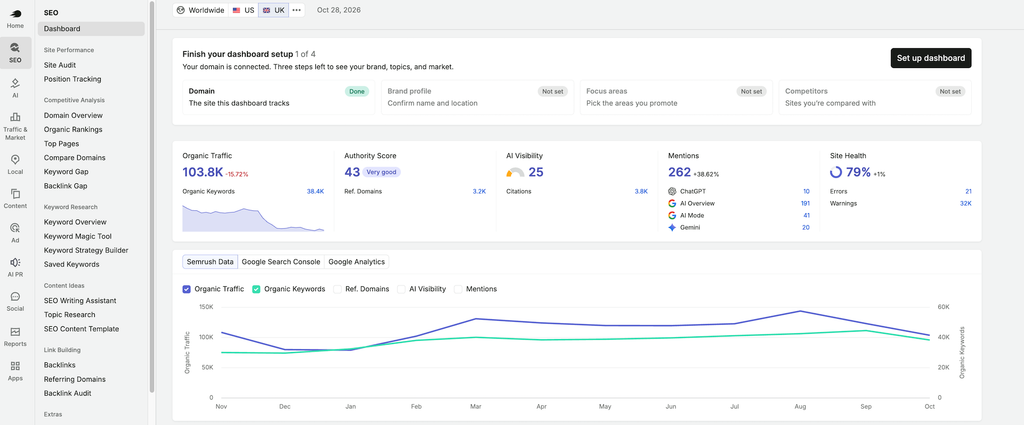
If you want one tool that covers almost everything, Semrush is hard to beat. It’s the one we use day-to-day for client work, and with over 4,000 reviews on G2, averaging 4.4 out of 5, it’s also the most-reviewed tool on this list. Our founder, Kate, is fast becoming known as ‘the Semrush girl’ on their social channels, but that’s down to how much we rely on it, not the other way round.
Its Keyword Magic Tool turns a single seed term into thousands of related keyword suggestions, complete with search volumes, difficulty scores and search intent, and you can filter everything by the UK database. Where Semrush pulls ahead is competitor keyword research. Pop in a competitor’s domain, and you’ll see the keywords they rank for, the pages bringing in their traffic, and the gaps you could fill.
It’s also moving quickly on AI search, which is worth paying attention to, since Semrush research found that visitors from AI search are more qualified and convert at 4.4 times the rate of traditional organic visitors. The AI Visibility Toolkit tracks how your brand shows up in answers from ChatGPT, Gemini, Perplexity and Google’s AI Overviews and suggests prompts worth targeting.
One of our favourite features is that Semrush connects straight to Claude. We pull live keyword data directly into our Claude projects and artifacts, then use it to plan content clusters around a core topic, check that keywords aren’t being cannibalised or repeated across different pages, and compare the search intent behind a keyword with the content we’re creating for it. It means our keyword research feeds into planning and quality checks in the same place we do the rest of our work.
Watch out for: the price. The SEO plan starts at £95.07 a month, and AI visibility tracking costs extra, either as an add-on or through the Semrush One plans from £161 a month. Extra users cost more too. The free plan is worth a try first, though its daily search limit runs out fast. If you do connect Semrush with Claude, also keep an eye on how many API credits you’re burning through – it helps to get Claude to predict the cost before you commit to a search.
2. SE Ranking: Best Value All-Rounder
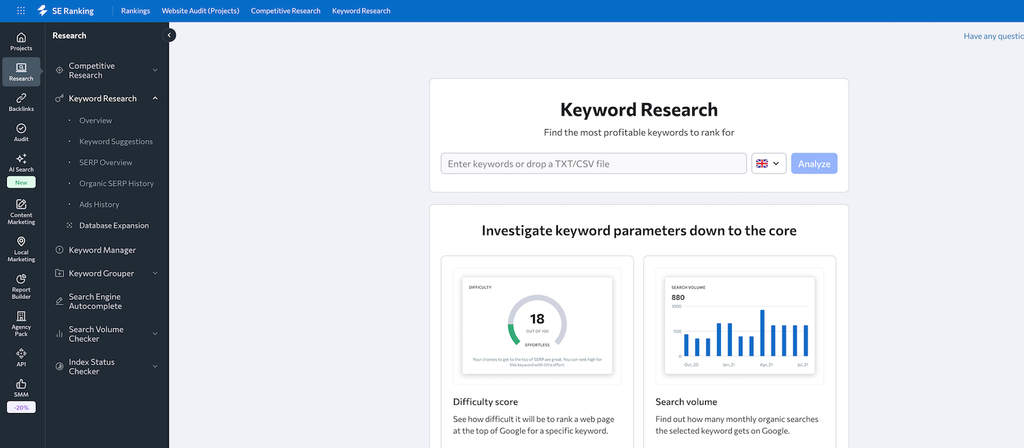
SE Ranking is the highest-rated among the big all-in-one suites, with a 4.8/5 rating from more than 1,400 G2 reviewers. Users regularly praise how easy it is to set up and how helpful the support team is, which makes a big difference when you don’t have time to learn a new SEO platform from scratch.
It covers the essentials well, with keyword research, competitor analysis and rank tracking drawing on a UK database of over 750 million keywords. Where it earns its value tag is the entry plan. For £95 a month (or £76 billed annually), Core gives you 2,000 keywords tracked daily plus 100 AI prompts a day, so you can see how your brand appears in AI search without paying for a separate toolkit. It also shows UK visitors prices in pounds, so there are no surprises at checkout, and there’s a 14-day free trial with no card needed.
Watch out for: in our experience, its data isn’t as reliable as Semrush’s. SE Ranking often shows search volumes for low-volume terms where Semrush shows nothing, which sounds helpful, but we can’t always tell if those numbers are real or if the tool is being a bit of a people pleaser. It’s worth sense-checking anything important before you build an SEO strategy around it. Extras like white-label reporting and additional AI prompts are paid add-ons, and SE Ranking overhauled its plans in early 2026, so older reviews often quote prices that no longer apply.
3. Google Search Console: Best Free Tool for Existing Sites
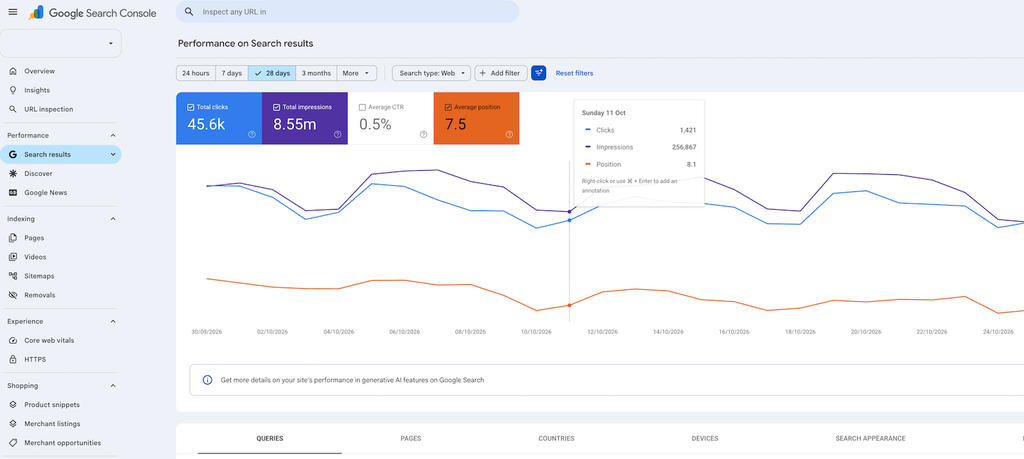
If your site already gets some traffic, Google Search Console is the most useful free keyword research tool you can get, because the data comes straight from Google. It scores 4.7 out of 5 from over 500 G2 reviews, and it’s one we check constantly.
We use it to see how each page is performing, from clicks and impressions to click-through rate and average position. Open any page, and you’ll see the exact queries it’s ranking for, which often turns up keywords you never set out to target. Filter by country to focus on UK searches, then look for pages sitting on page two. They’re usually the quickest wins, since a few tweaks to the copy or headings can be enough to nudge them onto page one. We also use it to see how a page responds after we’ve updated it.
Watch out for: it only shows data for your own site, so it won’t help with new keyword opportunities that you don’t rank for yet. There are no search volumes, only impressions, and the data only goes back 16 months.
4. AlsoAsked: Best for Question & Content Research
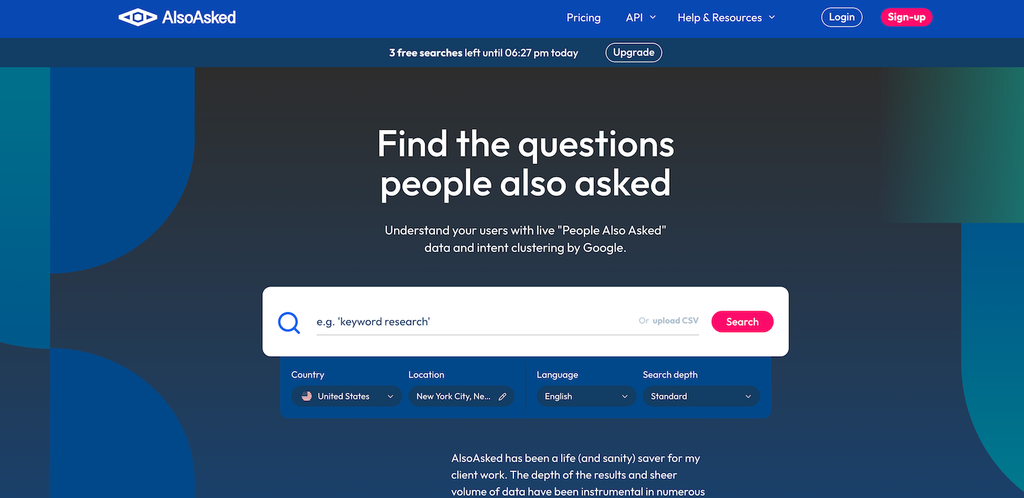
When you need to know what people want answered, AlsoAsked is a great place to start. It’s a UK-built tool, created by the team behind Norwich agency Candour, and it holds an impressive 4.8 out of 5 on G2, though from a smaller pool of 45 reviews.
Type in a topic and AlsoAsked pulls the questions from Google’s People Also Ask boxes, then maps them out as a tree, showing how one question leads to the next. You can set the location to the UK, so the questions reflect what people here are searching for. It’s ideal for planning FAQs, structuring blog posts around real questions, and writing the kind of clear, direct answers that Google’s AI Overviews tend to draw on.
Watch out for: it’s a question tool, so there are no search volumes or keyword difficulty scores. Pair it with Semrush or SE Ranking to check which questions are worth targeting. The free searches per day are handy for testing, and paid plans start at around £9 a month if you use it regularly.
5. Mangools KWFinder: The Underdog to Watch for Local Search
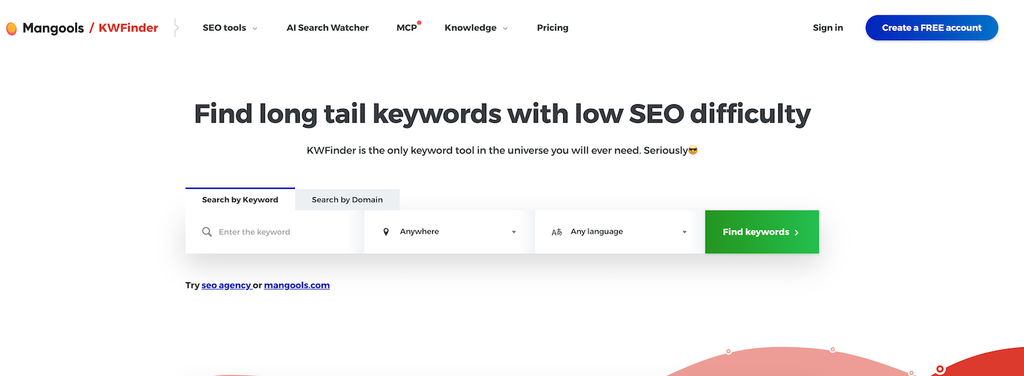
You might not have heard of KWFinder, and that’s exactly why it’s on this list. Built by Mangools, a small team based in Slovakia, it doesn’t have the brand recognition of Semrush, but it holds 4.7 out of 5 on G2 and has a real edge for local SEO.
Many tools stop at country-level data. KWFinder goes down to city level across more than 65,000 locations, so you can see how many people search for “emergency plumber” in Chelmsford compared with Leeds. For a local business, that’s the difference between targeting the whole of the UK and targeting the customers who can reach you.
As a keyword finder, it’s also surprisingly easy to use. The clean layout shows search volumes, difficulty scores and trends without burying you in menus, which makes it a good fit if you want to get on with it.
Watch out for: its database is smaller than the bigger alternatives and it has fewer features for competitor research and AI search. Cheaper plans come with daily lookup limits, and because it bills in US dollars, the price of around £28.33 a month can shift with exchange rates.
How to Choose the Right Keyword Research Tool
No single tool does everything perfectly, and you’ll often get the best results by using two or three together. Search Console shows what’s already working, AlsoAsked shows what people want answered, and a paid suite fills in search volumes and competitor data. The catch is that subscriptions stack up quickly, so decide what you need before you start signing up.
If You’re on a Budget
Start with Search Console and AlsoAsked’s free plan, as together, they’ll cover your current rankings and your audience’s questions for nothing. Add KWFinder at around £28.33 a month if you need search volumes, especially for local customers. If you can stretch to a full suite, SE Ranking covers most of what Semrush does for less. Our keyword research tips for small businesses will help you get more out of free tools too.
If Budget Isn’t an Issue
For breadth, Semrush covers keyword ideas, competitor research and AI visibility in one place. For depth, layer in a specialist, like AlsoAsked for question research or KWFinder for city-level data. And if AI search is a priority, pair Semrush’s AI Visibility Toolkit with our AI SEO services to turn the data into a plan.
Need help with keyword research? Let’s talk.
The right tools make keyword research quicker, but turning the data into a strategy that brings in leads takes time and experience. That’s where our SEO content strategy services come in. We’ll find the keywords worth targeting for your business, plan content around them, and keep an eye on how they perform across Google and AI search.
Work with us, and we’ll make sure you’ve got the right postcode from the start.
FAQs About Top Keyword Research Tools
What is the best keyword research software?
Semrush is the best tool for keyword research for most businesses, as it covers keyword ideas, competitor research and AI visibility in one platform. SE Ranking is the best-value alternative, with the highest G2 rating of the major SEO suites at 4.8 out of 5. The right tool for you depends on your budget, what you’re researching and how much time you have to learn a new platform.
How accurate is keyword data?
Keyword research data gives you a reliable guide to search demand, but search volumes are always estimates. Each tool uses its own data sources and calculations, so the same keyword often shows different volumes in different tools. For the most accurate picture, compare two tools and check the results against Google Search Console, which shows real impression data for your own site.
What is the best free keyword research tool?
Google Search Console is the best free tool for keyword research if your site already gets traffic, because its data comes directly from Google. For new websites or new topics, AlsoAsked’s free plan is the best free option for finding the questions people search for. Semrush and KWFinder also have free plans, but their daily search limits make them best for quick checks.
What is the most advanced keyword research tool for AI?
Semrush is the best tool for AI search keyword research, as its AI Visibility Toolkit tracks how brands appear in ChatGPT, Gemini, Perplexity and Google’s AI Overviews. SE Ranking is a more affordable option for AI search, with 100 AI prompts a day included in its Core plan from £95 a month. For creating content that appears in AI Overviews, AlsoAsked helps you find the questions people ask on Google.
Is Moz Keyword Explorer worth using?
Moz’s keyword tool is worth using if you want a simple way to uncover keyword opportunities and organise them into a keyword list. It draws on a large keyword database and gives each term a priority score, which helps you decide where to focus your research process. It didn’t make our top five because Semrush and SE Ranking cover more ground, from competitor research to AI visibility, but it’s a solid choice if you already use Moz Pro.
Is Google Keyword Planner good for SEO?
Google’s own keyword tool is good for SEO as a starting point, especially for keyword discovery around a single seed keyword. It’s built for Google Ads, so unless you’re running active ads, the free version shows search volumes in broad ranges and often misses the long-tail keyword ideas that are easier to rank for. Pair it with a dedicated SEO tool like Semrush or SE Ranking to build keyword strategies on more precise data.
What’s the best alternative to AnswerThePublic?
The best alternative to AnswerThePublic is AlsoAsked, which maps Google’s People Also Ask questions into easy-to-follow topic trees. Answer Socrates is a strong free alternative with keyword clustering, and Keywords People Use pulls questions from Reddit and Quora as well as Google. If you’d still like to try AnswerThePublic for visual question mapping, our guide on how to use Answer the Public for keyword research explains how to get the most from it.
